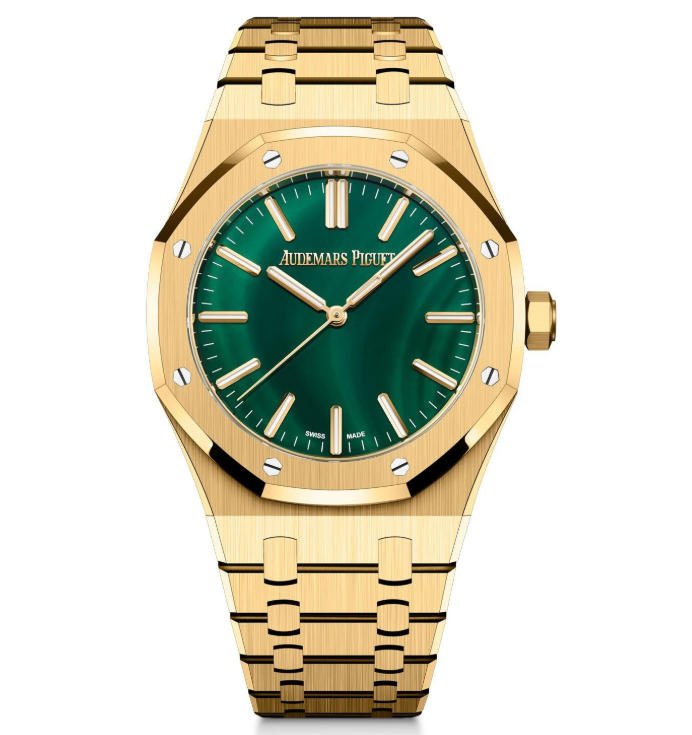

There is something immediately different about the 37mm Audemars Piguet Royal Oak with its green malachite dial. The octagonal bezel is familiar, the integrated bracelet is familiar, and the overall shape is unmistakably Royal Oak. Yet the dial changes the character of the watch far more than a simple colour change normally would.The Royal Oak Selfwinding ref. 15553BA.OO.1356BA.04 combines an 18-carat yellow gold case and bracelet with a polished natural malachite dial. A larger 41mm version follows the same idea, but the smaller watch feels particularly interesting because the stone sits inside a tighter frame. The result is less about adding decoration and more about changing the balance of a design people already know very well.For readers following replica watches in the UK, this is also a useful watch to study because the dial is not something that can be copied convincingly by matching a paint colour. Much of its appearance comes from the material itself.Malachite does not have a perfectly even pattern. The surface moves through different shades of green, with darker and lighter bands crossing the stone in irregular lines. That natural variation means one dial will never look exactly like another. It is one of the details that makes the 37mm Royal Oak with a natural malachite dial quite different from a Royal Oak using a conventional painted or textured finish.
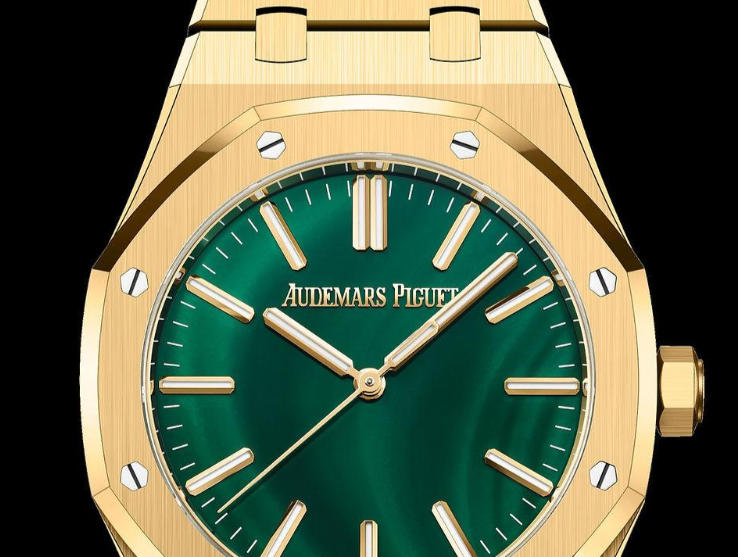
That difference becomes even more obvious because the Royal Oak is normally associated with a highly ordered dial. The familiar Tapisserie pattern is geometric and repetitive, while malachite is much less predictable. Putting an organic stone surface inside such an angular case gives the watch an unusual contrast without changing the basic Royal Oak shape.The absence of a date window also helps. There is very little interrupting the green surface beyond the applied hour markers, hands and central seconds. It keeps the dial open and allows the stone to do most of the visual work.The 37mm case measures 9.3mm thick, keeping the proportions relatively compact. The integrated bracelet still gives the watch a strong wrist presence, but the smaller diameter changes the relationship between the bezel, dial and bracelet. Compared with a larger Royal Oak, the dial feels more concentrated and the gold case appears slightly more substantial around it.
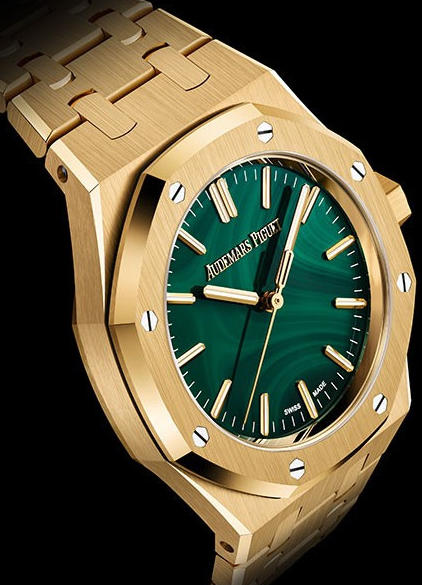
The 41mm version offers a broader view of the same material. Its larger dial gives the malachite pattern more room to spread out, while the smaller version keeps the green surface more contained. Neither approach is automatically better. They simply produce different proportions.The movement inside the original 37mm reference is the automatic Calibre 5909, while the larger 41mm model uses Calibre 4309. These specifications belong to the original Audemars Piguet watches and should not be treated as specifications for independently produced replicas.That distinction matters because movement descriptions are one of the areas where replica watch articles can easily become misleading. A watch may resemble the original from the front while using a completely different movement, case material or construction method. The same caution applies to water resistance and finishing claims.

Why the Dial Matters More Than Usual
Anyone looking at a replica inspired by this Royal Oak should start with the dial. Matching the general shade of green is only the first step. The harder part is recreating the depth, irregular banding and polished appearance of natural malachite.A printed green surface can look convincing in a small photograph, especially under strong lighting. Once viewed more closely, the difference between stone and a printed pattern can become much easier to notice. This is why natural malachite and printed green replica watch dials should not be treated as the same thing.The pattern itself also deserves attention. Natural malachite does not normally repeat in a perfectly regular way. Lines change direction, spacing varies and the colour transitions are not identical across the surface. A dial with repeated shapes or overly consistent striping may capture the idea of malachite without reproducing its natural character.At the same time, it would be a mistake to compare every watch against one official photograph and expect the pattern to match exactly. Natural stone varies from one piece to another. The important question is not whether the lines appear in exactly the same place, but whether the material looks convincingly organic.
The case is just as important. The Royal Oak depends on sharp transitions between brushed surfaces and polished edges. The bezel, case flanks and bracelet all rely on those contrasts. When the edges become too soft or the proportions are slightly wrong, the watch can lose much of the visual tension that makes the original design recognisable.This becomes especially noticeable on a 37mm case because there is less room for those proportions to hide. A bezel that is slightly too wide, a case that is too thick or a bracelet that does not taper correctly can change the appearance more than expected.The bracelet deserves the same level of attention. Its links are not simply attached to the case as a separate component. They form part of the Royal Oak’s overall shape, creating a continuous line from the case towards the wrist. The connection between the first bracelet links and the case is therefore one of the easiest areas to compare visually.These details are useful when looking through Audemars Piguet replica watches because the Royal Oak is a design where small differences tend to remain visible. The malachite version makes that even more obvious because the dial immediately attracts attention.It is also worth being cautious with descriptions of materials. A green dial that resembles malachite is not necessarily made from natural stone. A gold-coloured case does not necessarily use the same material as the original. Claims about movements, water resistance and case construction need evidence rather than assumption.
For UK readers comparing examples online, the differences between an original and replica Royal Oak 37mm are easier to understand when attention stays on visible details first. Dial texture, stone pattern, bezel shape, brushing, polishing and bracelet construction can all be compared from good photographs. Internal movement and material claims require more reliable documentation.That is what makes this particular Royal Oak interesting beyond its colour. The watch shows how much a familiar design can depend on the material placed inside it. The octagonal bezel and integrated bracelet have not changed dramatically, yet the malachite dial gives the whole watch a different personality.A replica can reproduce the general combination of green and gold, but the quality of the result depends on how carefully the dial, case and bracelet are made. Without examining a specific example, it would be misleading to claim that a green malachite Royal Oak replica uses the same materials or reaches the same finishing standard as the original.The 37mm version works because it does not try to add too much. There is no complicated dial layout competing with the stone and no unnecessary visual interruption. The attraction comes from the contrast between the natural green pattern and the precise geometry of the Royal Oak case.That contrast is also the reason this is a useful model for replica watch readers to examine closely. On a watch this simple, there are fewer places for inaccurate proportions, weak finishing or an artificial-looking dial to hide.